
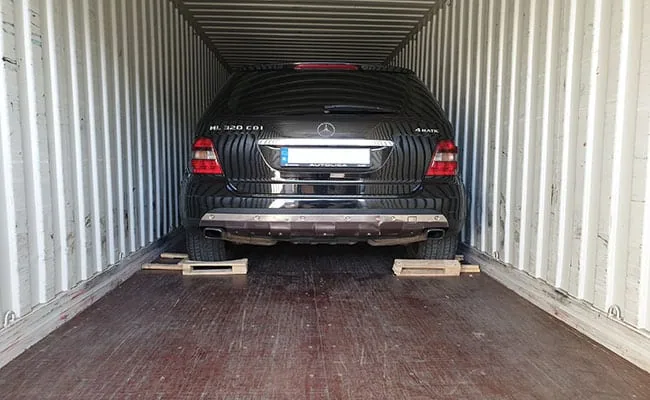
The transport of vehicles in a sea container is the safest, most controlled and traceable way to move a car, a motorbike, a van or even an industrial vehicle to the Canary Islands or any international destination. Unlike RoRo (roll-on/roll-off), where the vehicle travels "in the open" on a ship's deck, in a container the vehicle stays fully protected from the marine environment, knocks and handling. We explain how the process works, what advantages it offers and for which types of vehicles it is worth it.
How container transport works
The vehicle is loaded into a standard sea container of 20 feet (6.1 m long × 2.4 m wide × 2.6 m high) or 40 feet (12.2 m) and is secured with a system of certified lashings (straps, wooden wedges, anchor points on the chassis structure) to prevent any movement during the crossing. The container is closed with a numbered seal that is only opened at destination in the presence of the customer or their representative.
Container types by vehicle
- 20' container: fits 1 medium saloon car (Ford Focus, VW Golf) or 1 small SUV (Nissan Juke, Renault Captur)
- 40' container: fits 2 saloon cars or 1 large vehicle (Range Rover, van, boat on a trailer)
- 40' High Cube (HC) container: 30 cm more height, ideal for tall 4x4s, campers, vehicles with roof racks
- Open Top container: open roof, for vehicles that don't fit height-wise due to a tall body
- Flat Rack: platform with no walls or roof, for heavy machinery or extra-large vehicles
Advantages over RoRo (roll-on/roll-off)
1. Total protection against the environment
The vehicle is not exposed to sea salt, rain, wind or direct sunlight during the 5-10 days of the crossing. This is critical for:
- Classic cars and collector's vehicles (Porsche, vintage Mercedes-Benz, restorations)
- High-end cars with sensitive paintwork (Tesla, BMW M series, Audi RS, sports cars)
- Recently painted vehicles or ones with a recent restoration
- Premium motorbikes (BMW GS, Ducati Panigale, Harley-Davidson)
2. Ability to load belongings inside the vehicle
Since it travels in a closed, sealed container, you can fill the boot and rear seats with boxes (without exceeding the vehicle's load capacity and respecting dangerous goods regulations). This lets you combine the transport of the car with part of your removal in the same shipment.
3. Traceability and certified sealing
The container's seal number appears on the bill of lading (B/L) and on the DUA. At destination, it is only opened in your presence or that of the authorised agent. This reduces the risk of tampering, theft or swapping to zero.
4. Broader cargo insurance
Cargo insurance for containers covers practically every imaginable damage (accident, ship capsizing, theft, water damage, contamination). RoRo insurance is more limited and usually excludes minor cosmetic damage and scuffs during loading/unloading.
When container is NOT worth it
Container is more expensive than RoRo (between 30% and 80% more, depending on the route). For everyday-use cars with no sentimental or special market value, RoRo is perfectly valid and saves money. Container is worth it if:
- Your car has a market value over €30,000
- It's a classic, sports or collector's car
- You want to take the chance to also send part of your removal inside
- You're doing a long crossing (>10 days) where sea salt really does make a difference
- You have a premium motorbike (on RoRo they are poorly secured and vibrate)
The step-by-step process with Horizont Atlantic
1. Pickup at origin
We collect the vehicle from your home, garage or dealership. We carry out a 360° photographic report in the presence of the customer (condition of bodywork, paint, wheels, interior, mileage, fuel level) and sign a collection record.
2. Transfer to port and loading into the container
The vehicle is transferred to the port by tow truck or under its own power (with a professional driver). At the port it is loaded into the container with the help of ramps and the lashing team adjusts the anchor points according to the IMO IMDG standard (international maritime transport).
3. Sealing, B/L and shipping
Once the vehicle is secured, the container is sealed with a numbered seal. We send you by email the photo of the seal and the B/L (Bill of Lading) number, the "ID card of the shipment" during the crossing. The container is loaded onto the ship and sails according to the weekly schedule.
4. Sea crossing and paperwork
During the 5-10 days of the voyage, we handle in parallel all the customs and Canary Islands registration procedures where applicable. If the destination is the Canary Islands, we submit the DUA + AIEM + IEDMT with the vehicle's documents (registration certificate, technical data sheet, roadworthiness test, insurance).
5. Unloading and delivery
When the container arrives at the Canary Islands port, we notify you. Our team unseals it in the presence of the customer or authorised representative, checks the vehicle's condition against the collection record and delivers it to you or takes it to the agreed address.
Required documentation
- Valid vehicle registration certificate
- Technical data sheet (roadworthiness card) with valid roadworthiness test
- At least third-party insurance valid during transport
- Receipt for the current year's road tax
- Owner's ID/NIE or notarial authorisation if sent by another person
- For Canary Islands registration: proof of residence registration + original purchase invoice or declaration of age of the vehicle
Estimated cost
For a medium saloon car in a shared container (1 car per 20' container):
- Madrid → Tenerife/Las Palmas: €1,400-1,800
- Barcelona → Tenerife/Las Palmas: €1,500-1,900
- Seville → Tenerife/Las Palmas: €1,200-1,600
- International EU: €1,800-3,500 depending on country
- Non-EU: from €2,500 up to €8,000 (USA, Latin America, Asia)
An exclusive container (1 vehicle only + your removal) is between €2,800 and €4,500 from mainland Spain to the Canary Islands.
Canary Islands vehicle registration
If you're bringing the car as part of a change of residence, we handle:
- Application for IEDMT form 06
- Payment of AIEM where applicable (exempt if you qualify for the residence exemption)
- Change from mainland to Canary Islands insurance
- Roadworthiness test approved in the Canary Islands
- New Canary Islands number plate
More info at: Canary Islands tax regime and Bringing your car to the Canary Islands: procedures and options.
Special cases
Electric and hybrid cars
Under the IMDG regulation on lithium batteries, electric vehicles travel with the battery between 30% and 50% charge. This is an international protocol to reduce the risk of thermal fire during the crossing. Check that your car is within that range before pickup.
Motorbikes and bicycles
A motorbike takes up approximately 2 m³ in a container; 5-6 motorbikes fit in a 20' container. For bicycles, packing in a specific box and consolidating with other shipments is the most economical option.
Small boats
Boats and small craft up to 6 m fit in a 40' Open Top container. For longer vessels, Flat Rack or break bulk transport is used. Specific documentation (vessel registration, navigation certificate) which we also handle.
Request a quote
At Horizont Atlantic we have been transporting vehicles in containers from mainland Spain to the Canary Islands for 15 years. Ask us for a quote stating make, model, year and destination. We'll send you a fixed proposal within 24-48 hours, including third-party liability insurance and customs handling.
Frequently asked questions about vehicle transport in containers
What types of vehicles can be transported in a container?
Saloon cars (all sizes), SUVs, motorbikes, classic vehicles, electric vehicles (with a specific battery protocol), small vans. A 20-foot container holds 1 saloon car or 2 motorbikes. A 40-foot container holds 2-3 cars or 4-6 motorbikes depending on size. Large vehicles (vans, motorhomes) require Ro-Ro or flatrack platforms instead of a standard container.
Do you have to empty the car or can it be transported with things inside?
It's recommended to empty it completely: fuel tank almost empty (5-10 litres maximum under maritime safety regulations), empty boot, no loose objects that could move around, no important documents (ID, car papers) which should travel with you by plane. Some carriers DO allow boxes inside the car but with limitations (no more than 30% of the boot, well secured).
How much does it cost to send a car to the Canary Islands in a container?
From mainland Spain to the Canary Islands: €1,400-1,900 per saloon car in a standard container (port to port). Add €100-300 for door-to-door transfer at each end. If you share a container with another removal of yours (car + belongings), the cost per car drops to €1,000-1,500. Special vehicles (classics, high value) require specific insurance and packing.
What taxes do I pay when sending my car to the Canary Islands?
IEDMT (Special Tax on Certain Means of Transport) for registration in the Canary Islands: 0% for vehicles more than 1 year old since their first registration to another owner AND Canary Islands residence registration, 4-14% for new vehicles depending on CO2 emissions. AIEM on removal due to change of residence: exempt if you prove prior use and residence registration. Canary Islands registration fees: €100-300.
How long does transporting a car to the Canary Islands take?
Door to door: 10-15 days from request. Sea transit: 5-9 days by ship from a mainland Spain port (Cádiz, Valencia, Barcelona, Bilbao). Pickup at origin + delivery at destination + customs procedures: 3-5 additional days. More detail: differences between types of removal.
Want to book the shipment? Check out our car and vehicle transport service to the Canary Islands.