
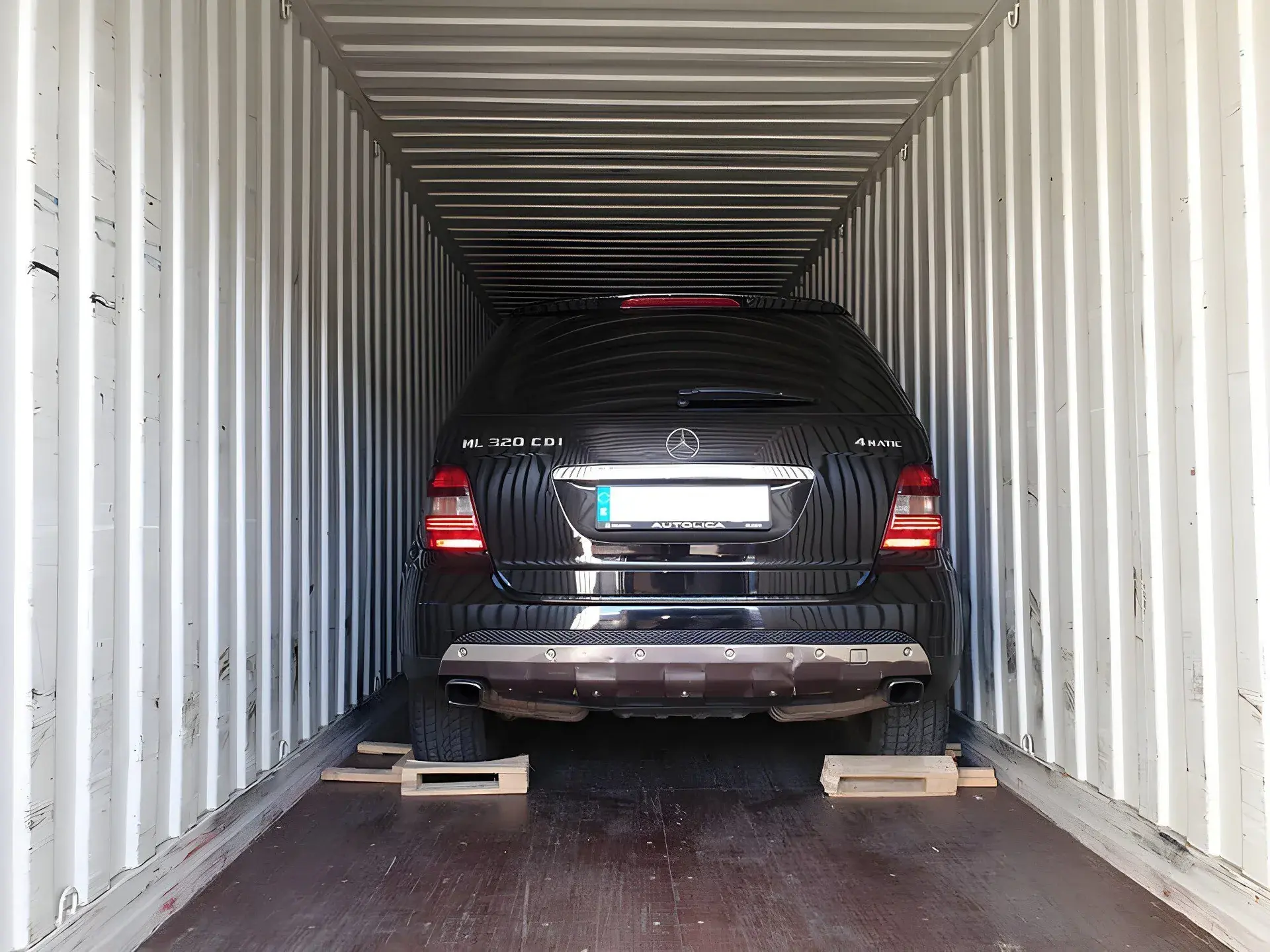
Taking your car when you return to mainland Spain is almost always more cost-effective than selling it here and buying another there, but it's important to know that the invoice has three items, not one: maritime transport, customs management, and taxes. With over 15 years moving vehicles and relocations between the Canary Islands and mainland Spain, at Horizont Atlantic we explain what it really costs, what documents you need, and when you don't pay VAT.
The three cost items
1. Maritime transport
It's the big item. A standard passenger car on routes between the Canary Islands and mainland Spain moves, as a rough guide, between 1,200 € and 1,800 € door to door. The range depends on:
- The island of origin: from Tenerife or Gran Canaria there is direct departure; from Lanzarote, Fuerteventura, La Palma, La Gomera or El Hierro an additional inter-island hop is added beforehand.
- The mainland port of arrival: Cádiz, Valencia or Barcelona, and from there the road distribution to your address.
- The size of the vehicle: a motorcycle is considerably cheaper; an SUV, van or motorhome increase it, because the price is based on cubic meters or linear meters of cargo hold.
- The method: in rolling hold (the car is driven in) or in a container (more protected and the natural option if it goes with your move).
- Door to door or port to port: if you deliver and pick up at the port, you save on pickup and delivery, but you lose convenience.
2. Customs management
Taking a vehicle out of the Canary Islands is not just any domestic shipment: you have to submit the DUA and clear it. This involves customs agent fees and, depending on the port, some port or handling fees. It's a smaller figure compared to freight, but it exists and should appear itemized in the budget. If the car travels within your move, it is normally cleared in the same DUA as your household goods and the procedure is not duplicated.
3. Taxes: here's the surprise
The Canary Islands are outside the VAT application territory. Therefore, importing a car into mainland Spain from the islands is considered an import and, in principle, incurs VAT (21 %) on the value of the vehicle. On a car valued at 10,000 € that would be 2,100 €, considerably more than the transport itself.
The key is that there is the exemption for change of habitual residence. If you're really moving—it's not a disguised sale—and the car is part of your personal belongings, you can apply for it. The requirements, in general terms, are to have had your habitual residence in the Canary Islands for the minimum required period, the vehicle must be your property and in use before the move, import it within the deadline following the change of residence, and not sell it during the period of residence set by the regulation. It is justified with the certificate of de-registration from the Canary Islands municipal register, registration in the new municipality, and the vehicle documentation.
It's advisable to check your specific case with the Tax Authority or the customs agent before shipping: if you don't qualify for the exemption, VAT is paid and it's the difference between a cheap and an expensive operation.
Summary of approximate costs
| Item | Approximate amount | Notes |
|---|---|---|
| Transport of a passenger car | 1,200 € – 1,800 € | Door to door, depending on island, destination and size |
| Motorcycle | Considerably less | Takes up much less space |
| Van, SUV or motorhome | Above the range | Quoted by volume or linear meter |
| DUA and clearance | Smaller item | Shared with the move if they travel together |
| Import VAT | 21 % of value, or 0 € | Exempt if change of habitual residence applies |
| Transport insurance | According to declared value | Advisable to declare the real value |
These are market references to guide you, not a tariff: the final price depends on the route, dates and vehicle. We work with fixed quotes, with itemized costs.
What documentation you need
- Driving permit and technical data sheet (ITV card) of the vehicle.
- Current ITV. With an expired ITV, clearance and subsequent circulation become complicated; check it before shipping.
- National ID or NIE of the owner.
- Current vehicle insurance.
- Proof of change of residence if you are going to request the exemption: de-registration from the municipal register in the Canary Islands, registration in the mainland municipality and, if applicable, employment or rental contract.
- Customs representation authorization in favor of whoever processes the DUA.
Do you need to change the license plate?
No. A car registered in the Canary Islands has a Spanish license plate: it is not re-registered nor is the driving permit changed by moving to mainland Spain. What you do need to do is update your address with the DGT and take it into account for the circulation tax, which is paid to the municipality where you are registered (and which in many Canary Islands municipalities is cheaper than on mainland Spain).
Different is the registration tax (IEDMT): it was accrued when registering the car, with the rates that apply in the Canary Islands. If the vehicle was recently registered and the move is recent, specifically ask the Tax Authority if any adjustment applies in your case, because the answer depends on dates and personal circumstances. If the movement is the other way around, you have the details in our guide to IEDMT in the Canary Islands.
How long it takes
The maritime transit is the same as for a move: around 5 days to Cádiz, 6 to Valencia and 7 to Barcelona, plus land distribution to your city if the destination is inland, where the whole usually takes about 9 days. To that you have to add pickup and customs clearance. In summer the slots fill up: if you have a date, book with plenty of time.
Rolling hold or container
In rolling hold the car is driven onto the ship. It's the most common and most economical. In container the vehicle is enclosed and protected from the weather and scratches, and is the logical option if it travels with your move or if the car is classic, sports or high value. If you take it along with the furniture, using the same container usually works out better price-wise than contracting the two services separately.
Mistakes that cost you
- Putting things inside the car. The vehicle travels empty: personal effects inside are not covered by insurance and can block customs clearance. If you have things to carry, they go with the move.
- Going with a full tank. For safety, you are asked to keep it almost empty, around a quarter.
- Not documenting the previous condition. Take photos of the car from all four sides on the day of delivery: it's your proof if a dent appears.
- Taking the exemption for granted. If you don't meet the requirements for change of residence, VAT appears at the end and throws off your budget.
- Leaving it to the last minute. Departures are weekly or fortnightly depending on the line; improvising is expensive.
Is it worth taking it or selling it here?
The practical rule: if the car is worth significantly more than the cost of the move and you are VAT exempt, it's almost always worth taking it, especially if it's recent or well-maintained. If it's a low-value vehicle, with many years or with the ITV about to expire, it's often better to sell it before you go. Do the math with the real resale price on the island, not with what you'd like it to be worth.
Take it with the move
The most convenient is to integrate everything into a single service: household goods and vehicle in the same shipment, a single DUA and a single point of contact. You have the details of the complete move on our page of moves from the Canary Islands to mainland Spain, and of the vehicle service on transport of cars and vehicles. If what you need is the incoming route, check out moves to the Canary Islands from mainland Spain.
Do you want figures for your specific case? Tell us the model, island and destination and we'll prepare you a fixed quote with transport, procedures and insurance itemized.