
Freight to the Canary Islands
Transport of general palletised freight to the Canary Islands
Request a quoteAt Horizont Atlantic we operate freight transport to the Canary Islands with weekly departures from the Peninsula and inter-island service. We cover maritime transport, urgent air and combined, with full container, groupage or pallet, and we fully manage customs clearance: DUA, AIEM and IGIC processed by us.
Routes and modalities
- Peninsula → the Canary Islands: regular maritime line with shipment from Cádiz, Valencia and Barcelona. Typical transit 5-7 days.
- Inter-island: inter-island connections from Tenerife and Gran Canaria to La Palma, La Gomera, El Hierro, Lanzarote and Fuerteventura.
- Large volumes: 20' and 40' HC containers, platforms and flat-rack for machinery, construction or industrial equipment.
- Urgent air: daily connections from Madrid and Barcelona when timing prevails over price.
Who we work for
We provide service to companies and businesses that supply the Canary Islands on a regular basis—construction, distribution, retail, food service, agriculture—and to occasional shipments from individuals or SMEs. In all cases we stow, seal and consolidate the cargo at our facilities before shipping.
Frequently Asked Questions
How long does maritime transport to the Canary Islands take?
Do you manage the DUA, IGIC and AIEM?
Do you do inter-island transport?
Can I send just a pallet?
Why choose us?
Request a quote
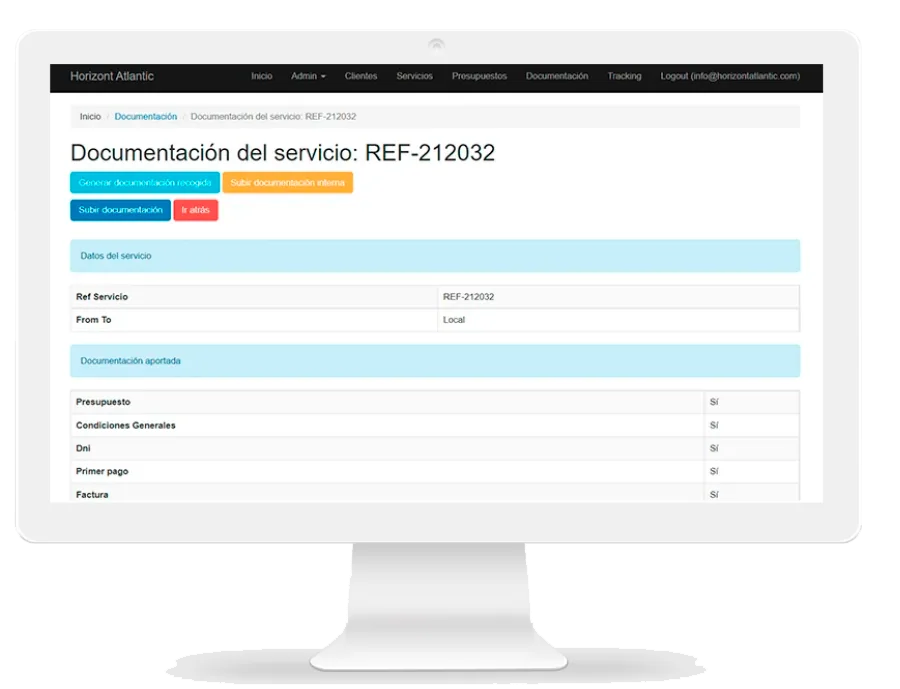
Online tracking
After over 15 years repeating the same processes countless times, we set out to create an intuitive, functional tool.
- We optimise the time to upload and sign documents
- We make online tracking easy
- We simplify payments and invoicing
Express Service: weekly vessel schedule to the Canary Islands
The Express Service operates on fixed weekly departures from the main mainland Spanish ports. Your departure and arrival dates are confirmed at the time of booking. It is the fastest and most predictable option. Compatible with a shared container (groupage) or a dedicated container.
| Port of departure | Vessel departure | Collection cut-off | Vessel arrival | Delivery time | Booking |
|---|---|---|---|---|---|
| Barcelona | Friday | Monday / Tuesday of the same week | Wednesday of the following week | 4–6 days from clearance | 1 week before collection |
| Valencia | Saturday | Monday / Tuesday of the same week | Thursday of the following week | 4–6 days from clearance | 1 week before collection |
| Alicante | Friday | Monday / Tuesday of the same week | Monday of the following week | 4–6 days from clearance | 1 week before collection |
| Seville | Monday, Friday | 7 days before departure | 4 calendar days | 4–5 days from clearance | 1 week before collection |
| Vigo | Thursday | Tuesday / Wednesday of the previous week | Saturday of the same week | 4–5 days from clearance | 1 week before collection |
| Gijón | Friday | Monday / Tuesday of the same week | Saturday of the following week | 4–5 days from clearance | 1 week before collection |
| Bilbao | Saturday | Monday / Tuesday of the same week | Saturday of the following week | 6–8 days from clearance | 1 week before collection |
Combined / Economy Service
The Combined Service (also known as the Economy Service) consolidates your cargo with that of other customers in a shared container and dispatches it once the container is full. It is the lowest-cost option, ideal for non-urgent shipments.
Delivery times are variable and depend on how quickly the container fills on each route. There is therefore no fixed schedule: each request requires checking current availability at the time of shipment.
To find out the price and estimated departure date of the next combined container on your route, request a personalised quote:
How to read vessel dates
The maritime schedule for the Express Service is governed by two standard milestones that are worth understanding before planning your shipment.
ETD — Estimated Time of Departure (vessel departure)
This is the scheduled sailing date from the mainland port. To reserve space in the container, the operation must be notified to Horizont Atlantic at least one week in advance of the collection cut-off date shown in the table. This allows us to organise the packaging logistics, home collection and port consolidation. For example, for a collection in Madrid, cargo typically sails via Valencia (the nearest port). If you wished to sail on a specific Saturday, we would need to have the booking confirmed at least seven days beforehand.
ETA — Estimated Time of Arrival (vessel arrival)
This is the scheduled arrival date of the vessel at the main islands: Santa Cruz de Tenerife and Las Palmas de Gran Canaria. Once in port, the container goes through:
- Customs clearance and Canary Islands taxes.
- Transport of the container from the port to our facilities at Polígono Industrial El Mayorazgo.
- Deconsolidation of the cargo (in the case of groupage).
- Transfer to a delivery vehicle for final delivery.
This is why the vessel arrival date does not coincide with the delivery date. The "delivery time" column adds the 4–8 days this process takes. For deliveries to Fuerteventura, Lanzarote, La Gomera or El Hierro, add a further 72 hours for the second inter-island leg. We manage every step without any intervention required from the customer, keeping you informed at each milestone.
The European pallet (EUR-pallet)
Palletised cargo greatly simplifies road, sea and air transport. It is worth familiarising yourself with the standard specifications before preparing your shipment.
History and standardisation
The pallet emerged from the 1960s onwards as a response to the need to standardise cargo handling. Its introduction reduced loading times by between 20% and 35% and revolutionised the entire global logistics chain.
Materials and mandatory markings
The frame is made of wood (increasingly plastic for chemical or food industries). Every European pallet must carry the following markings:
- EPAL stamp (European Pallet Association) in oval form.
- IPPC marking, guaranteeing the origin of the wood (mandatory since 2010).
- Heat treatment method (HT — Heat Treatment) certification.
- Repair nail if the pallet has been repaired.
- Manufacturer licence number.
Weights, dimensions and capacity
The European standard EUR-pallet measures 1,200 × 800 mm. This size allows exactly 33 pallets to be loaded in a standard trailer, placed width- or length-wise. An empty pallet weighs approximately 25 kg and its useful load capacity reaches 1,500 kg.
Advantages of palletised transport
- Universal compatibility across air, sea and road transport.
- Fast handling with a forklift at origin and destination.
- Standardisation of industrial machinery (production lines, automated warehouses).
- Optimised hold space and reduced in-transit damage.
Transport of dangerous goods (ADR)
The ADR agreement was signed in Europe on 30 September 1957 and entered into force in 1968. It regulates the road transport of goods classified as dangerous, defining how they must be packaged, labelled, documented and transported.
Characteristics of ADR transport
The convention sets requirements for transport vehicles (certified vehicles, fire extinguishers, panels), for packaging (UN-approved containers) and for the documentation that must accompany the cargo (ADR consignment note, safety data sheet). The purpose of this entire regulatory framework is to protect people and the environment during transit.
Visible ADR markings
ADR vehicles display an orange rectangular plate divided into two bands:
- Upper band: Kemler code of 2–3 digits identifying the type of hazard (flammable, toxic, corrosive, etc.).
- Lower band: UN number of 4 digits identifying the substance being transported.
At Horizont Atlantic we manage ADR transport to the Canary Islands by coordinating the entire chain with authorised shipping companies, ensuring regulatory compliance from origin to final destination.