
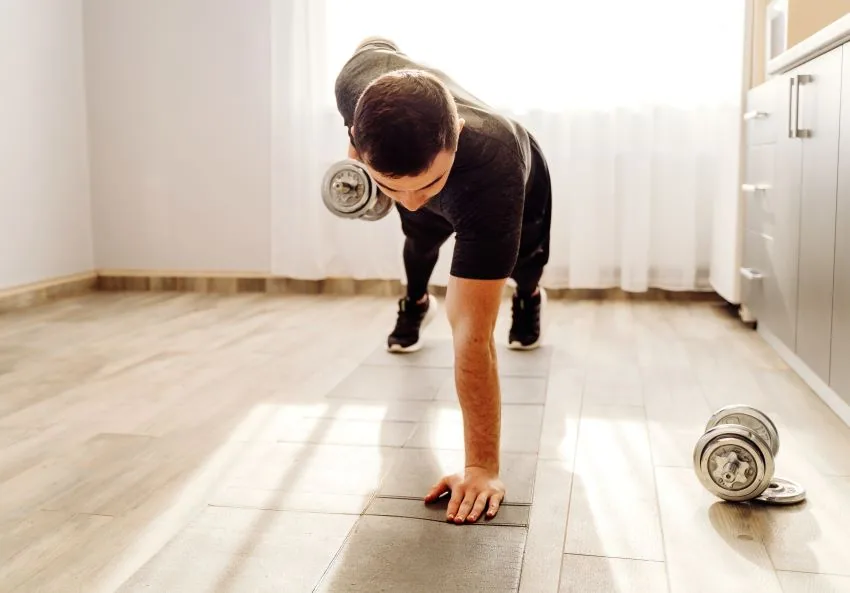
If you have a spare room in your home, you can take the opportunity to transform it into a gym. Many homes have a room that becomes free when children move out or for other reasons. In such cases, the usual approach is to leave it as a storage room, convert it into a dressing room, or even turn it into a gym. Today we show you how to do the latter — or rather, what steps you need to take to create your own home gym room.
Tips for converting a room in your home into a gym
Having a gym at home is not difficult. Your equipment may be more limited than that of a sports centre, but you can always rely on multifunctional machines and tools and those you will use most often. Here are some key tips for your home gym room.
Store all the belongings from the room
The first step is to clear the space. If the room was previously used as a bedroom, you will need to remove the bed, chest of drawers, wardrobe, bedside tables… If it was an office, you will need to do the same with the office furniture and other items.
To store all these belongings, we recommend that you rent one of our storage units or our furniture storage service, as at Horizont Atlantic we offer storage spaces of up to 32 m2 to cover all kinds of needs. If you choose this option, you won’t have to worry about cluttering other rooms in the house, which would greatly limit your ability to move around freely.
Choose a well-ventilated room
If you have the option of choosing which space to use for your gym, look for a well-ventilated room. When we exercise, we sweat, and sweat produces odours. Ventilation helps to eliminate that unpleasant smell.
If you don’t have a room with a window at home that you can adapt as a gym and that you open frequently, you will need to opt for well-ventilated spaces from the inside, where there is plenty of airflow.
How to equip your gym
Beyond having a well-ventilated and spacious room, you need to equip it properly, with mats, machines and other apparatus. You may not be able to get all the equipment you want, so select the items you will use most and those that are most functional.
A good initial selection includes: a treadmill, a stationary bike or an elliptical trainer, a rowing machine, weights, resistance bands, exercise mats, a medicine ball, a fitball, a bench, a plyo box, and weight plates and bars.
A third important point is how to decorate a gym room. The goal here is to make it an attractive and motivating space. Home gyms need bright, bold colours, as they help stimulate the body and boost motivation.
Storage space in the gym
Another idea for your home gym is to include storage space. Try to always keep this space tidy — don’t leave everything in a mess. Many machines can be folded and stored away, and other items can be kept in designated spaces.
You can opt for shelves to hang the bar and weight plates, drawers or boxes for bands and mats, and even a wardrobe if you need more space.
A home gym room should have enough machines and tools, while also having room for storage. It is also essential that it is well decorated to encourage physical activity. With these principles in mind, you are ready to get started.
Frequently asked questions about setting up a home gym
How many square metres do I need as a minimum for a home gym?
For cardio + basic weights: 8–12 m² is sufficient (treadmill or bike + bench + dumbbells). For a complete training setup with a rack, bench and barbell: 15–20 m². For CrossFit with space for jumps and wide movements: 25+ m². The key factor is ceiling height (minimum 2.40 m for overhead press or jumps).
What is the best flooring for a home gym?
Rubber flooring (rolls of 4–10 mm thickness, sold by the m²) absorbs impact, protects the original floor, reduces noise for neighbours and provides better grip. For heavy weight zones (>50 kg), use 15–20 mm thickness or specific modular tiles. Cost: 20–50 €/m² depending on quality. Do NOT use carpet or bare parquet under weights.
How can I avoid disturbing neighbours with a home gym?
Use thick rubber flooring, avoid jumping and dropping weights (use elastomeric or rubber bumper plates if you want to drop them without noise), train at reasonable hours (not before 9 am or after 10 pm), partially soundproof the walls if you make a lot of noise, and train with headphones (not a speaker system).
How much does it cost to set up a decent home gym?
Basic setup (dumbbells, bench, mat, flooring): 400–800 €. Intermediate setup (rack, bench, Olympic barbell, plates up to 100 kg, rubber flooring, cardio machine): 1,500–3,000 €. Full professional setup: 5,000–10,000 €. Compared to a commercial gym (50 €/month × 12 months × 3 years = 1,800 €), it pays for itself quickly with intensive use.
What if I have a gym in a small room with neighbours below?
Limit your equipment to: a mat, adjustable dumbbells (Bowflex, NordicTrack), resistance bands, TRX hung in a door frame, a quiet stationary bike, a rowing machine (Hydrow, Concept2 if budget allows). Avoid: heavy free weights, machines with industrial pulleys, treadmills (very noisy). More on adapting small spaces: organising a small room.