
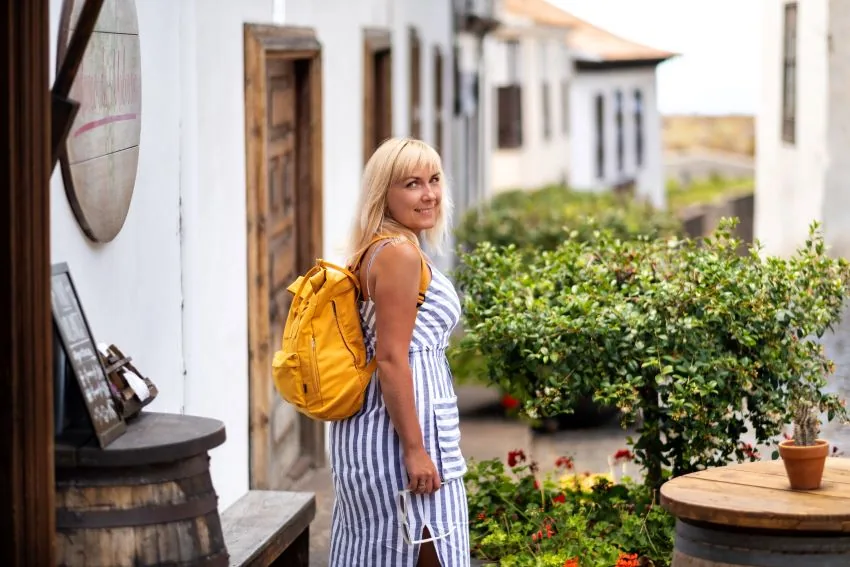
Living in Tenerife presents an almost irresistible incentive, which is the mild climate found on this island and throughout the archipelago throughout the year. It is always spring, even in December. To this we must add the infinite number of landscapes to contemplate within a radius of just 50 kilometers: beach, mountain, forest, urban spaces, small villages…
We show you some tips for living in Tenerife highlighting some very attractive areas for their combination of urban services and proximity to wilder and more untamed nature.
Tips for starting to live in Tenerife
Which is the best area of Tenerife to live in?, Where to live in Tenerife with children?, What advantages does residing on the island offer at a tax level?, How are the connections with the mainland? … These are some of the questions that many people ask themselves when considering moving to Tenerife.
The best part of Tenerife: the capital or any of its other major municipalities
San Cristóbal de la Laguna, better known as La Laguna, is the most populated municipality in the province after Santa Cruz de Tenerife. In these two locations you will find all kinds of facilities such as shopping centers, cinemas, parks, health services, good connections and places for cycling or practicing sports.
San Cristobal de La Laguna is characterized by being a relatively small town, it was named a UNESCO World Heritage Site in 1999, so we can assure you that its streets and buildings have undeniable charm.
On the other hand La Laguna has an Astrophysical Observatory and the University of La Laguna, the first in the Canary Islands.
Santa Cruz de Tenerife, in addition to being the provincial capital, is a cutting-edge city that welcomes many mainland Spanish residents and immigrants from various countries, especially South Americans. Being the financial city, the countless job opportunities can be an attraction for people who want to work while enjoying the benefits of living on this island.
Beyond these two locations, municipalities such as Arona, Adeje or Granadilla de Abona are also very interesting for living in Tenerife with children due to their supply of educational and health services, as well as leisure activities.
The Southern zone of Tenerife is mainly tourist-oriented and is known as the second residence of citizens from Northern European countries, as these people are attracted by the mild climate of this island.
The cost of living is more economical in the Canary Islands
The Canary Islands enjoy an insularity regime that translates into lower tax payments. There is no VAT in the archipelago, but there is the Canary General Indirect Tax (IGIC), which has five brackets ranging from 0% to much higher rates. However, most products are taxed at a rate of 7%.
In turn, there are other expenses that are practically exempt on the islands, such as the practical absence of parking fees, the absence of tolls on roads and interesting issues related to the climate such as the fact that heating or air conditioning is practically never necessary throughout the year.
Having an average temperature of about 25 degrees throughout the year, this energy saving is at least an incentive to establish residence on this island.
Travel to the mainland and between islands
All islands have an airport or airfield, except La Graciosa. In Tenerife there are also two, so the best area of Tenerife to live in, from a purely infrastructure perspective, will be the one that is well connected to these spaces.
However, the small islands, which are all except the two that host the provincial capitals, offer a slower flight schedule, there is a later connection with the Iberian Peninsula and the rest of the islands.
Moreover, all of them also have ports for making connections via sea. Several shipping companies operate maritime lines with weekly frequency allowing you to board your car, with the journey taking approximately 36 hours.
In this way, the best area of Tenerife to live in, if we talk about the entire province, is the island of Tenerife itself, in its most populated municipalities.
Living in Tenerife means enjoying a very mild climate throughout the year, but with the difficulties inherent to being an ultra-peripheral territory, very far from the continent. The best way to solve this issue is to live on the island of Tenerife itself.
With all this, it can be affirmed that the option of considering carrying out a move to Tenerife and establishing a tax residence can offer countless advantages that are worth considering.
Frequently asked questions about living in Tenerife
Which area of Tenerife is best to live in?
It depends on priorities. South (Adeje, Arona) if you value sunshine all year round and international lifestyle. North (Puerto, Orotava) if you prefer cooler climate, nature and affordable prices. Santa Cruz/La Laguna if you need complete urban services and work. Detailed comparison in south of Tenerife and north of Tenerife.
How much does it cost to live in Tenerife as a couple without children?
Realistic estimate (2026): rent 600-1,200 €/month (variable by area), utilities (electricity/water/gas/internet) 150-250 €, community 30-80 €, food 350-500 €, transport 100-300 €, leisure 200-500 €. Reasonable monthly total for comfortable life as a couple: 1,800-3,000 €. Cheaper than Madrid/Barcelona, slightly more expensive than medium-sized mainland cities.
Is it necessary to have a car in Tenerife?
In central urban areas (Santa Cruz center, La Laguna center) you can live without a car: good network of buses + tram. In the rest of the island (south, residential north, outskirts) practically essential: buses have limited frequencies and the mountainous geography makes distances feel long. To visit and enjoy the island, the car is freedom.
How is the climate in Tenerife throughout the year?
Exceptional. Average coastal temperature: 18-26°C all year round (lows rarely below 14°C in winter, highs rarely above 30°C in summer). Differences by area: south warmer and drier (24-28°C annual average), north cooler and more humid (20-23°C annual average, more rain and "panza de burro"). Teide peak can have snow in winter.
And the disadvantages of living in Tenerife?
Insularity (price of cars, appliances, imported products more expensive and with longer delivery times), more limited job market (except tourism, technology in ZEC, health, education), distance from family/friends on the mainland (cheap flights due to resident discount but travel time), calima 4-8 days a year (Sahara dust). For most, the advantages more than compensate.
Preparing your move to the island? Discover our moves in Tenerife with fixed price and local team.