
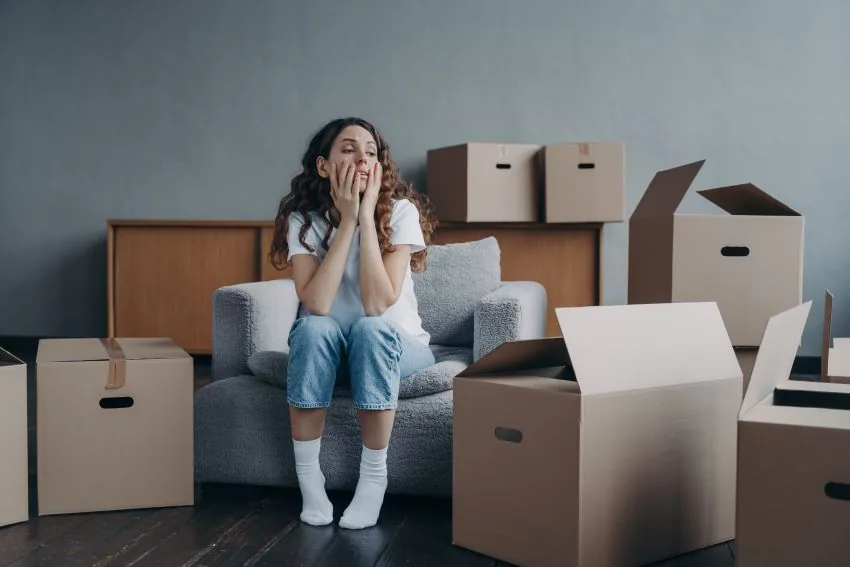
Fear of changing cities is something very common, since it involves breaking with an established routine and saying goodbye to places and people that are part of our lives. However, there are times when change can be as necessary as it is mandatory, and in that case there is no choice but to face our fears to move forward.
Why you're afraid to change cities
Irrational fear of moving house or city is known as tropophobia. It is an anxiety-related disorder, and people who suffer from it can experience a range of physical and emotional symptoms of varying severity. However, without reaching the extreme of tropophobia, everyone can experience fear and unease at the idea of moving to another city. It is a perfectly normal fear, which can even be adaptive and provide the energy needed to make the change and face the new challenge.
The unknown always generates some fear, especially when we know we will have to start from scratch in another place. It means having to say goodbye to everything we have built in a place that is already familiar to us, to build again in a different place.
To this is added the fear of making a wrong decision, the stress of starting a new job or the fear that the situation could overwhelm us. Not to mention the tension that a move produces in itself, from a logistical point of view.
Advice for facing this situation and moving
To not be afraid of change, it is essential to have a positive mindset. Any change can bring very good things, many of which never happen if we remain stuck in our comfort zone.
It is also necessary to value the courage, which is there, even if it coexists with fear. We are about to take a crucial step and test ourselves, and that requires courage. But also, once the decision to move has been made, we can follow some advice.
Cleaning
Moving is a great opportunity to get rid of what we don't use or doesn't serve us. Sometimes, the material things we accumulate are a reflection of our emotional burdens. We can take this cleaning ritual as a metaphor applied to our life in general and to the fact of starting over, lighter of baggage.
Getting familiar
If possible, it is a good idea to visit the new area to get to know where we are going to live. Walking through the neighborhood to see what atmosphere it has at different times of the day, knowing the key places, knowing where the supermarkets and important shops are, all of this can help a lot to reduce the stress of change.
Take your time
To face the fear of changing cities and make the move less stressful, you need to set a reasonable timeframe (several months in advance). This way, you can carry out the necessary procedures with some calm, while our mind gradually assimilates the idea of the coming change.
Delegate
The fear of change is a burden that can be relieved if we get all the hassle of moving out of our heads. This can be a great help to start off on the right foot. At Horizont Atlantic we can take care of tasks such as organization, packing, transport and subsequent unpacking in the destination city.
In summary, if you are about to face a move and you are afraid to change cities, accept that it is normal, take your time and ask for help to make everything simpler.
Frequently asked questions about fear of changing cities
Is it normal to be afraid before an important move?
Yes, absolutely. Fear of change is a natural response of the brain to uncertainty. People more rooted in their environment (years in the same neighborhood, stable social network, consolidated routine) experience more anticipatory anxiety. It is not a sign of weakness or a bad decision: it is normal processing of a major event.
How to decide if the move is really worthwhile or just an impulse?
List concrete pros/cons (not abstract). If the pros include: better job, better house, better climate, better quality of life or pressing family need, the move has a solid basis. If they are only vague reasons ("I need change", "I'm fed up"), it's best to delve deeper first. Talking it over with someone you trust outside your current environment helps you gain perspective.
How long will it take me to feel "at home" in a new city?
Average time to feel comfortable: 3-6 months. Average time to feel truly integrated (local social network, "your" places, stable routines): 12-18 months. It is faster if: you have children in school (you necessarily know families), you work in person (you know colleagues), you have a hobby with local community (sports, music, volunteering).
Is it worthwhile to maintain a double life (frequent visits to your origin)?
The first 3-6 months yes: 1-2 monthly visits to your origin maintain the network and reduce anxiety. From the 6th month onwards, it's better to reduce visits to 1 every 2-3 months to force local integration. Returning "every weekend" for a long time makes it difficult to create a new life at your destination.
And if after the move I don't adapt and want to come back?
Give yourself a realistic minimum timeframe (ideally 12 months) before making a decision to return. The first weeks/months have a negative bias (everything is new, you can't find anything, you miss what you know). If after 12 months and having tried to integrate, the feeling of not fitting in persists, it is a serious signal to consider returning. More about adaptation: avoid post-move anxiety.
When changing cities is also a change of islands, a good part of the dizziness is purely logistical: what you're taking, how much it costs, and how long it takes to arrive. That certainly has a straightforward answer — look at how moves to the Canary Islands from the Mainland work or request a no-obligation quote and decide with the figures in front of you.