First and foremost, we must indicate that these terms apply not only to maritime transport but also to any means of transport. The term Incoterms is the abbreviation of the English words ( International Commercial Terms ).
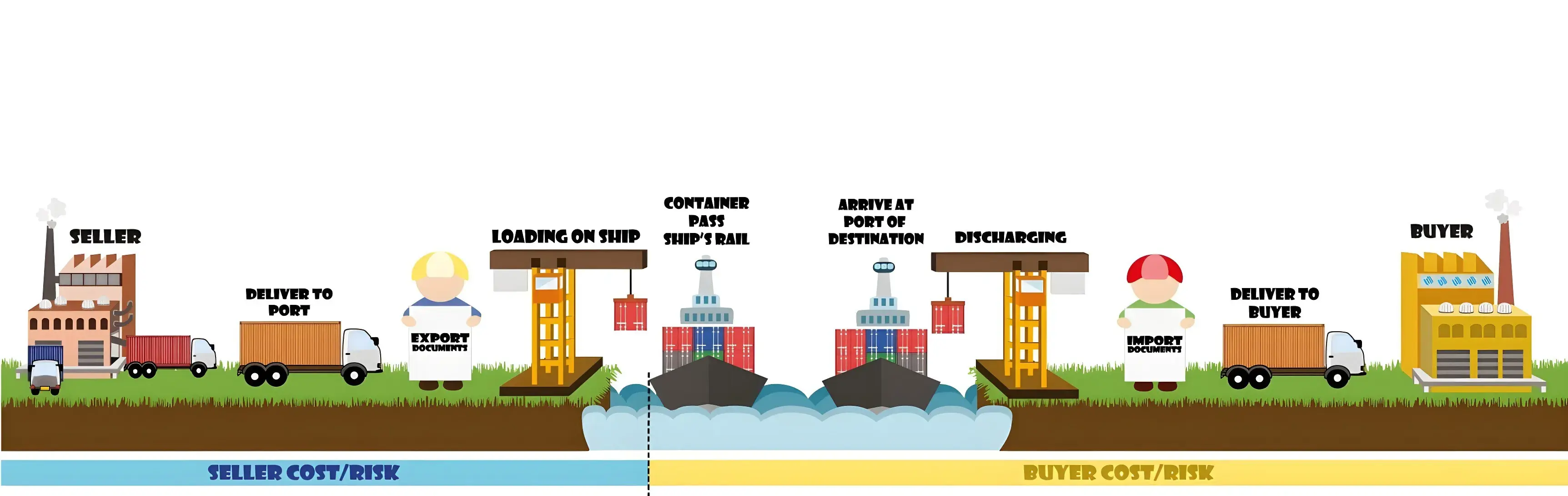
On the other hand, it should be noted that these acronyms resolve the moment at which the responsibility is transferred between both parties. This point is of great importance as indicated by the Secretariat of the United Nations Commission for International Commercial Law (UNCITRAL).
Why were Incoterms created?
First of all, we must take into account to understand the birth of Incoterms the complexity of a goods transaction between merchants from different countries. On the one hand, as international commerce began to gain more prominence and an increasing number of transactions began to take place between buyers and sellers from different countries, the first problems due to disagreement on the conditions in which they were carried out began to arise. It is for this reason that in 1936 the International Chamber of Commerce coined these terms. In this way they emerged as a means of harmonization of international goods purchase-sale operations.
What are Incoterms 2020?
The meaning depends on the three-digit term we use and in all of them the commercial conditions of international goods purchase-sale are established. These conditions are established between the buyer and the seller. On the other hand, Incoterms are not legal rules that are mandatory to comply with. Rather, they are standardization and harmonization norms. First and foremost, we can find a series of fundamental points for which Incoterms establish a series of clarifying criteria:
Where the goods must be delivered:
It establishes the place where the seller must deliver the goods. It is established with the letters E and D in both cases it is known as direct delivery. On the other hand, when third parties intervene that receive or deliver the goods terms F and C will be applied. For example, in the event that it is transferred to a freight forwarder who will be responsible for transport.
Where the risk of the shipment is transferred:
On the other hand, it should be noted that this is a very important point that determines from what moment, once the sale of the goods is established, the seller transfers the risk to the buyer.
How expenses are distributed in a commercial shipment
It should be noted that in most cases it is the buyer who assumes the transport expenses. Attributing to the seller the operations necessary to put the goods in delivery conditions at the agreed place. On the other hand, there are a total of about 4 cases in which the seller assumes the transport expenses. These are C terms.
Who carries out customs procedures
In most cases it is the seller who assumes the customs procedures at the origin. It should be noted that there is only one Incoterm in which the buyer assumes this management. It is also common to hire freight forwarders. EXW (Ex Works, At the works). In the rest of cases it is the seller who assumes these procedures, expanding to the destination for example in the event that DDP (Delivered Duty Paid, Delivered duty paid) is stipulated.
 Who updates Incoterms?
The organization responsible for updating Incoterms is the ICC ( International Chamber of Commerce ). This chamber has been updating Incoterms since 1936, applying and implementing to the present day the changes that have emerged in international transport
Classification and Types.
Incoterms are divided into four types or categories.
Terms in E EXW:
EXW : Ex-works
In this case, the buyer assumes all transport-related expenses from the origin. The seller only has the responsibility to put the goods in time and in proper form at the factory so that the buyer can directly collect them or hire a freight forwarder to manage the transport.
Terms in F FCA, FAS and FOB:
In this case, the seller is entrusted with delivering the goods to a freight forwarder or carrier assigned by the buyer, the latter being the one who assumes the expenses.
FAS : Free Alongside Ship
This Incoterm is specific to bulk goods, the seller delivers the goods at the agreed loading port, with the buyer assuming all loading expenses, freight, ship unloading and import clearance. Customs procedures at the departure port are the responsibility of the seller.
FOB : Free on Board
In this case, the terms of the agreement regarding the moment of delivery and the transfer of the risk of the shipment are made on the ship. The expenses being up to this moment the responsibility of the seller and from that point on the expenses are the responsibility of the seller. On the other hand, this Incoterm has the particularity that it is used only for transport by international ship, whether fluvial or maritime. It is used for all types of goods that are not bulk.
FCA : Free Carrier
The seller undertakes to deliver the cargo at a place agreed upon between the parties. This place will be11 in the country of origin. It can be a warehouse of a third party, for example a freight forwarder's warehouse or any other place agreed previously. The costs incurred up to this moment are at the seller's expense. This incoterm can be used in maritime, fluvial and multimodal transport.
Terms in C CFR , CIF, CPT
CFR : Cost and Freight
This widely used Incoterm stipulates an agreement in which the seller bears the expenses of the main transport from the origin to the destination port covering all expenses. On the other hand, it must be clarified that the risk of the shipment is transferred from the moment the goods are delivered on board the ship. It is not applicable to bulk cargo.
CIF: Cost Insurance and Freight
Transport will be at the seller's expense until the destination port, including the contracting of insurance whose beneficiary will be the buyer. The risk of the shipment is transferred from the moment of loading the ship at the port of origin. With the use of this Incoterm, the Customs value is established with which the payment of tariffs in the destination country will be set. It can only be used in maritime transport.
CPT : Carrier paid to
The seller is responsible for all transport expenses, including insurance. The risk of the shipment is transferred when delivery is made to the freight forwarder in the destination country. This Incoterm can be used in any international transport regardless of the means used.
CIP: Carriage and Insurance Paid to
The seller is responsible for insurance and transport to the agreed place at the destination port. The beneficiary of the insurance policy is the buyer. In the review of Incoterms 2020 ICC-A clauses are established.
Terms in D DPU,DAP,DDP
DPU : Delivery at place unload
Under this rule, it is established that the seller delivers the goods at the destination place assigned by the buyer. The buyer must manage the import clearance.
DAP: Delivered At Place
In this Incoterm the seller assumes the cost of transport and assumes the cost of insurance to the agreed place ready for unloading in a vehicle. Import clearance is the responsibility of the buyer, who must dispatch the goods on time at the risk that if they do not, terminal expenses may be incurred that they will have to pay.
DDP: Delivered Duty Paid
This is the broadest and simplest Incoterm in terms of ease of contracting and purchasing goods. In this case, the seller assumes all the costs of the shipment to the place in the destination country previously agreed. The seller also assumes the customs clearance procedures at the destination and the payment of taxes if applicable.
Frequently asked questions about Incoterms and moves to the Canary Islands
What are Incoterms and why do they matter in a move to the Canary Islands?
Incoterms (International Commercial Terms) are international rules that define who pays what (transport, customs, insurance) in an international trade operation. Although your move is personal and not commercial, shipping companies and customs agents use them in quotes. The most common in moves to the Canary Islands: DDP, DAP, FOB.
What does DDP (Delivered Duty Paid) mean?
"Delivered with duties paid": the carrier takes care of everything, including customs, until delivery at your door. For a move, it is the most convenient option: you pay a fixed price and the company manages all the customs paperwork (DUA, AIEM, IGIC). It is the most commonly used model by individuals.
And FOB (Free on Board)? What is it used for in a move?
"Free on board": the carrier delivers your move loaded on the ship at the port of origin. From there on, you are the one who contracts shipping companies, manages customs and procedures at the destination. Only recommended for people with experience in maritime operations. For private moves, it almost never pays off.
What customs documents do I need when sending a container to the Canary Islands?
For a move due to change of residence with AIEM exemption: DUA (Single Administrative Document) presented by a customs agent, registration certificate in the Canary Islands (or promise to register), detailed and valued inventory, invoice for the moving service, transport document (Bill of Lading or B/L), proof of ownership of the belongings.
Who pays for the marine voyage insurance?
In DDP, the carrier includes it in their price (RC insurance + optional declared value additional). In FOB, you contract it directly with a marine insurer. Make sure you know what level of coverage you have: basic maritime RC covers ~500 €/m³, while full declared value covers the real value of your belongings. More on types: differences between types of moves.
These terms are not theory: we apply them when quoting every shipment that leaves the mainland territory. We use them in our international moves and in container transport to the Canary Islands. If you're not sure which Incoterm is right for you, tell us the origin and destination and we'll work it out for you.
These are the Incoterms we apply in transport of goods to the Canary Islands from the Peninsula, depending on who assumes customs, insurance and unloading at the destination.