
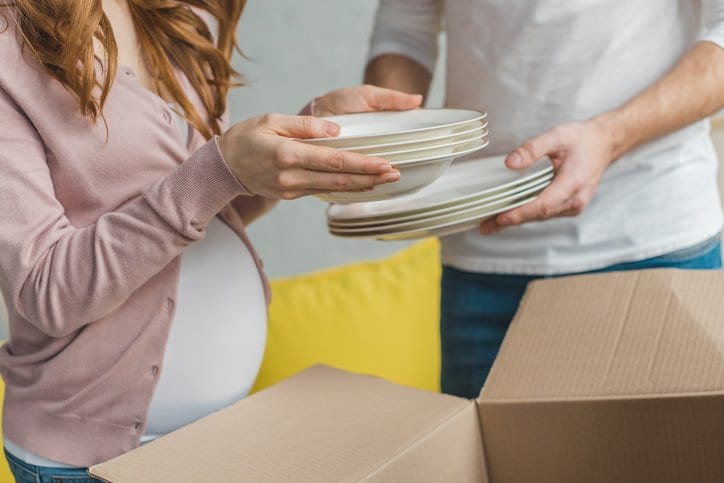
In the following post we are going to provide some brief tips for packing dishware in the correct way.
When carrying out a move, we always have doubts about how to pack our dishware, plates, glassware and decorative objects in the most correct way. This work is relatively simple if we follow these small tips.
The success of good packing by 99% will depend on the care and time we dedicate to this work. It will also depend on the amount of material used.
The first tip is not to skimp on the amount of material we use. The saying better too much than not enough can be a maxim when carrying out this task. On the other hand, we have to remember to make responsible use of the amount of material we use. Surely this material will be for single use and we should recycle it after packing the dishware.
Secondly, we have to make a list of the quantity of glassware, glasses, plates and porcelain objects we have. This way we can calculate how much material we need to buy. We can buy this material in the main DIY stores, hardware stores and specialized shops. On the other hand, you can also buy packing material in our online shop.
Secondly, the material we have to use is kraft paper or bubble wrap. These materials will be used by individually wrapping each piece of dishware or glassware. We will place a small layer of crumpled paper at the bottom of the box. The first pieces we will put in the boxes are the heaviest (soup tureens, large trays, etc.). As we fill the box, we will place lighter pieces on top.
Thirdly, we will take into account the way to place the glasses inside the boxes. The correct way is to place them next to each other lying down (horizontal position) and set back. We have all played Tetris at some point because the way we had to place these blocks fitted together will be the same way in which we should place the glasses. On the other hand, the plates also have a correct position inside the box. This way is to place them parallel to the base of the box. Never standing upright on the edge.
Fourthly, we will take into account the size of the boxes we use. These should be approximately 40 cm x 40 cm x 40 cm in size and not larger. Of course, this will logically increase the number of boxes we use. But this way we will ensure that everything arrives in perfect condition.
Fifthly, we must take into account that these boxes will have considerable weight, so when closing them we will use quality packing tape, in some stores this material is not of good quality. It is even possible that they have lost their ability to stick. So check before buying it if it is in good condition. Peel off about 3 cm. of a strip and touch the inner part with your finger, if when trying to peel the finger you notice that small threads form, it means the tape is in good condition. So you can use it for the packing work without problems.
Finally, keep in mind that this work must be done carefully so that we ensure the transport of our most fragile objects. Since in most of these several companies are involved and our boxes undergo several handling operations. We can also insure the load by filling out the valued inventory for insurance and our belongings will be covered against any damage. Although in this case the moving company will be in charge of packing all the objects.
Frequently asked questions about dishware packing
What is the best way to pack plates for a move?
Individual plates wrapped in newspaper or tissue paper (plenty of paper, don't skimp), placed vertically (not horizontally stacked) inside the box, with crumpled paper filling in the gaps. Vertical position drastically reduces breakage: pressure is distributed by the plate edge, much more resistant.
What about glasses? Do they always break?
Only if packed badly. Each glass or cup with its own paper (plenty of paper), grouped in boxes with dividers (sold specifically for glassware) or between layers of cardboard. Crystal glasses: horizontally with paper between each one and between rows. DO NOT mix with heavy objects on top.
Is a specific box needed for dishware or does any box work?
If the move is short and you pack well with enough paper, a double-wall cardboard box works perfectly. For collections of good dishware (porcelain, Lalique crystal, collector's glassware), boxes with dividers are much safer. You can find them in packing stores from 5-10 €.
What is the maximum weight per dishware box?
Maximum 15-20 kg per box. Boxes that are too heavy break when lifted, pressure deforms lower plates and they are difficult to handle. Better several small-medium boxes than one large full one. Label each box as "FRAGILE - DISHWARE - DO NOT INVERT - MEDIUM WEIGHT".
Does my moving insurance cover broken dishware?
The company's base RC insurance covers accidental breakages in transport if the dishware is correctly packed. It does NOT cover breakages due to deficient packing by the customer themselves. If your dishware is high value (Bohemian crystal, antique porcelain), take out insurance at declared value. More about general packing: professional labeling system.
Dishware is what breaks most when packed in a rush and at the last minute. If you prefer not to risk it, professional packing is included in our moves in Tenerife: the glassware travels in compartmented boxes and with insurance on the contents. Request a quote.